The conference is about to start, but more languages are required. What to do?
- i. Context
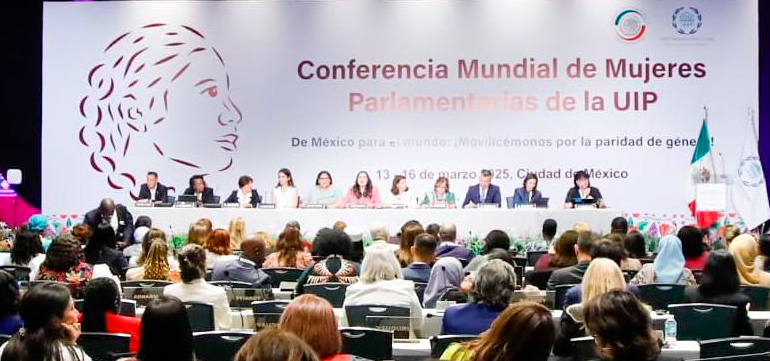
- The Global Conference of Women Parliamentarians of the Inter-Parliamentary Union (IPU) was about to begin in Mexico City. The Organizing Committee had planned booths and interpreters for the official languages of the IPU (Arabic, Spanish, French and English) and had asked delegations to advise if they would be bringing their own interpreters and if they needed interpreting booths. More delegations that expected requested this service, and some did so only at the last moment.
- ii. Challenges
- 1. Lack of space for the booths: Not only were more booths needed than originally planned, but the interest generated by the event obliged the organizers to expand the capacity of the venue, occupying part of the space set aside for the interpreting booths.
- 2. Schedule: Some delegations requests booths the day before the event, when everything had already been set up.
- iii. Solution
- 1. The booths for the official languages were set up on a mezzanine that offered visibility of the conference room.
- 2. The booths requested in plenty of time were set up in an adjacent space furnished with closed-circuit screens.
- 3. Meanwhile, virtual booths were provided for languages requested at the last moment, and these interpreters worked remotely.
- 4. Delegations also had the option to employ consecutive interpretation to interpret their speakers into one of the official languages, and then use simultaneous interpretation into the other languages.
- iv. Results
- 1. Interpretation was offered in Arabic, Spanish, French, English, Japanese, Persian, Russian and Turkish, exceeding initial expectations.
- 2. The event achieved access to languages for all delegations, maintaining quality of interpreting and finding logistical solutions to all the challenges arising from the high demand and last-minute requests
- Planning of interpreting services for global events has to be flexible and take into account unexpected or last-minute requirements for different languages.
- The combination of human, consecutive, and simultaneous interpretation, in addition to technological resources (virtual booths, closed-circuit screens), makes it possible to cover a broader range of linguistic needs.
- Collaboration between organizers, interpreters and delegations was key to the success, quickly adapting to demand and optimizing space and resources.
Return to Success Stories
