An innovative system for furnishing an online meeting platform with virtual simultaneous interpreting booths
- i. Challenge
- Find a solution for a multilingual event (10 languages) for 13,000 attendees that was originally designed to be in-person to be held remotely with simultaneous interpretation when the online meeting platform already contracted did not meet the basic requirements for this
- ii. Context
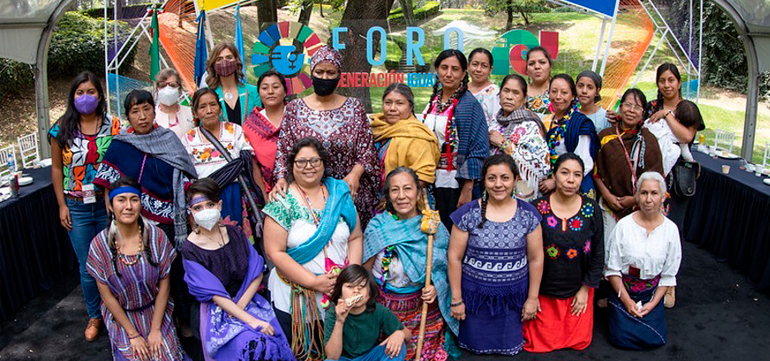
- 1. In 2021, the Covid-19 pandemic forced the Generation Equality Forum, planned for Mexico City, to move online.
- 2. Each of the sessions had to operate with a minimum of 6 languages (Arabic, Chinese, Spanish, French, English and Russian) and a maximum of 10, including Nahuatl. In addition, interpretation into international sign language was required.
- 3. Although the virtual platform chosen for the Forum did have several audio channels, it lacked a mechanism to enable collaboration between the interpreters who would be working on each of the sessions, which meant that:
a. The interpreters working in the same language couldn’t monitor each other, share resources or pass each other the mic easily and smoothly.
b. There was no way for the interpreters to listen to their colleagues working in other languages, meaning that the only way to ensure full interlinguistic communication would be for all the interpreters hired to understand all the languages involved—up to 10! - 4. Covid health guidelines meant that the interpreters had to work from different locations.
- 5. Since the participants could not travel, the sessions took place across different time zones, extending the working day for the organizing committee and the support team.
- 6. An online event of this scale had never been attempted, much less with interpreting into so many languages.
- iii. Solution
- 1. We trained dozens of interpreters in the use of virtual booths for remote interpreting.
- 2. Respecting the health guidelines, we used our network of remote interpreting studios, with interpreters working from 8 countries on 4 continents.
- 3. Our IT team designed a system enabling the interpreters to work in virtual booths and the different languages to be injected into the virtual meeting platform previously selected by the client.
- iv. Results
- 1. Communication flowed in as many as 10 languages at the 57 sessions of the Forum.
- 2. For the first time, interpretation into an Indigenous Mexican language was provided at a Forum of this scale.
- 3. It was demonstrated that remote interpretation is feasible at events of this size, and from that moment on, the main online meeting platforms began to incorporate some kind of virtual booth into their systems (although most are still very poor).
- 4. Remote interpreting platforms (which have sophisticated virtual booths) have designed mechanisms for injecting interpretation into the audio channels of the principal online meeting platforms.

Return to Success Stories
